Friday, February 7, 2014

Bentos

I recently took a class at the Hiroshima YMCA on bento box making. Bentos are popular in Japan as a single portion take-out meal from a restaurant or a home-packed meal. All the Japanese children in L & J's school classes bring one every day and now they want me to send one with them too. The funny thing is that I doubt L& J would really eat anything in the bento boxes.  Bento boxes usually included rice, fish or meat, and pickled or cooked vegetables.
Here is a picture of typical bento box an adult would buy from a restaurant:
 
Mother's Day bento
(Thank you to justbento.com for the picture)
 
 Here is a picture of a more American child friendly bento:
Rilakkuma Sandwich Bento
This is super cute and the kids would eat this. I just don't know if I want to get up even earlier to cut shapes out of cheese!
 
Here is the bento I made at my class:

Our bento boxes included sushi, cooked egg, pickled radish and carrot, sweet beans, grapes,  tomatoes, and cooked meat.
 
I have now found one thing that I want to take back to the USA and that is a jubako box. A jubako box  refers to a box consisting of two to five stacked sub-boxes, in which food is stored. We had a Japanese family over to our house for dinner and the mother brought her food in a jubako wrapped in a furoshiki (scarf). It was beautiful!!!
Here is an example of a jubako box that you can buy on ebay (they are a little bit nicer here though):
 Vintage Japanese Lacquered  Lunch Box Three-tiered Jubako  hand painted


Luke's birthday!

Luke is officially 6 years old!
On his officially birthday we headed to an indoor playground afterschool and stopped by McDonalds afterwards. In the USA the kids hated McDonalds, but here in Japan they love it due to the happy meals or "Hapi Setto" as they say here. The happy meals here include these Japanese toys the kids love and there is a choice of a pancakes for a meal- so Luke is sold!
Luke decided to have a Ninjago-lego themed birthday party and he invited 6 children from his school class, since he was turning 6 years old. It was quite the international birthday with friends from Japan, Mexico, USA, and Ukraine!


Tuesday, January 21, 2014

Happy New Years!

Happy Year of the Horse!
The Japanese New Year celebration, Oshugatsu, is the biggest holiday in Japan. The New Year celebration often lasts an entire week somewhere around December 28th-January 6th. Leading up to New Year’s Eve, all the Japanese housewives spend their time "osoji" (cleaning) as part of the Oshogatsu ritual—a Japanese equivalent of “spring cleaning.”  The Japanese believe this is a good time to “purify” one’s environment—allowing for a fresh start for the coming twelve months. After cleaning is completed then it is on to cooking large amounts of food that can be easily stored for the Japanese housewives. The intention behind this custom is that once January 1st comes everyone can rest for 3 days. I asked a lady at church if she was getting ready for the new year and she just moaned.  I might have to agree with her- it sounds exhausting!
Celebrating the new year in Japan also means paying special attention to the first time something is done in the new year. Hatsuhinode is the first sunrise of the year. Before sunrise on January 1, people often drive to the coast or climb a mountain so that they can see the first sunrise of the new year. Many people in Hiroshima drive or hike up to the silver peace pagoda on the top of Mt. Futaba-yama. 
 
View from the Peace Pagoda
View of Hiroshima from Mt. Futaba-yama (thanks to ja.japantourist.jp- since we were too lazy!)
Hatsumōde is the first trip to a shrine or temple.
Many people visit a shrine after midnight on December 31 or sometime during the day on January 1. If the weather is good, people often dress up or wear kimonos. Since we have small children we skipped seeing the first sunrise but did venture out to Hiroshima Gokoku Jinja Shrine next to the Hiroshima Castle. As you can tell it was very busy! We ventured out with our expat friends and had a good time sampling the food booths as we waiting in line to enter the shrine, toured the grounds of the Hiroshima Castle, and enjoying the decorated shrine.


 Our friends, The Gepford family waiting patiently!
 
Here is a picture of our decorated lobby. In the middle is the traditional kagami-mochi decoration, 2 mochi (boiled rice cakes) stacked with a tangerine on top. You will also see kadomatsu decorations everywhere too. Our apartment complex had a picture of one posted, but every department store, train station, school, sometimes even 7-elevens had real ones placed out in front of their buildings.
Kadomatsu M1181.jpg
Kadomatsu Decoration


Sunday, January 19, 2014

Pacific War Museum

Part of our time on Guam we visited the Pacific War Museum. It was a fantastic little museum with actual military vehicles used during WWII on the island and displays on Guam's role in WWII. All of it was of particular interest to myself since my Grandpa Minick served on a submarine in WWII in that part of the Pacific Ocean.  Here are some pictures and little bit of history.


 The United States took control of Guam in the 1898 Spanish-American War, as part of the Treaty of Paris. Guam came to serve as a station for American ships traveling to and from the Philippines from that time forth. During World War II, Guam was attacked and invaded by the armed forces of Japan on December 8, 1941. This is the same day that Japan attacked Pearl Harbor (Japan is a day ahead in time of Hawaii and mainland United States). The attacks were intended as a preventive action in order to keep the U.S. Pacific Fleet from interfering with military actions the Empire of Japan was planning in Southeast Asia against overseas territories of the United Kingdom, the Netherlands, and the United States. There were simultaneous Japanese attacks on the U.S.-held Philippines and on the British Empire in Malaya, Singapore, and Hong Kong.
 
Guam's Japanese occupation lasted for approximately thirty-one months.  Approximately one thousand people died during the occupation, according to Congressional Testimony in 2004. Some historians estimate that war violence killed 10% of Guam's some 20,000 population.
The United States returned and fought the Battle of Guam on July 21, 1944, to recapture the island from Japanese military occupation. More than 18,000 Japanese were killed as only 485 surrendered. Sergeant Shoichi Yokoi, who surrendered in January 1972, appears to have been the last confirmed Japanese holdout in Guam


One of the most fascinating displays was about a Japanese soldier who hid for 28 years in the central part of the island in the jungle instead of surrendering. Sergeant Yokoi went into hiding during the Battle of Guam in 1944 and was found in January of 1972. He hid in an underground jungle cave, fearing to come out of hiding even after finding leaflets declaring World War II had ended, believing them to be false Allied propaganda. Yokoi survived by hunting, primarily at night and using native plants to make clothes, bedding, and storage implements, which he carefully hid in his cave. After being found by 2 local men he returned to Japan and continued to live another 25 years until he died in 1997.
This is a picture of him receiving his first haircut in 28 years. (Picture taken from Wikipedia.org)

Christmas

Ever wanted to travel to a tropical island for the holidays? You look at the pictures of white sand beaches, blue waters, and lots of sunshine from your home in the midst the cold, gray, snowy, rainy winter months and think someday....!! Well, we actually made our "someday dream" come true this year. For Christmas we headed down to the island of Guam and spent 4 days soaking in the sunshine and enjoying 86F weather everyday. Guam is the largest and southernmost of the Mariana Islands. The island is an unincorporated territory of the United States in the Western Pacific Ocean.
Guam is only about a 3 1/2 hour flight from Hiroshima and with some unused United Airline miles leftover from the summer that were going to expire in January we were sold.
Everyone had a great time. The kids could not get enough of the ocean and the hotel's pool. We did a little bit of exploring the island but really spent most of the time in the water.
 
 
 View of the coast line of Tumon Bay from Two Lover's Point.
 
 
Luke and Cameron at the beach!
 

 The hotel we stayed at had an awesome pool facility with 2 waterslides, a winding river you could swim in, a children's pool, and 3 other pools. The kids spent every waking minute on the water slides. As always we had to take a picture of Cameron with his googles on- his favorite form of eye protection!


Thursday, January 16, 2014

Turkey day, also known as Costco rotisserie chicken day

Obviously, Thanksgiving is an American holiday and not celebrated in Japan, but I couldn't pass up the opportunity to celebrate it even if were are thousands of miles from the U.S.A. It feels good to say that 2013 was a good year for our family. I don't think we could have said the same for 2011 and 2012 due to Mike's health issues. But I am happy to report that for the first time in 2 years Mike was healthy and able to eat a real Thanksgiving dinner and that we were surrounded by many new loving and kind friends.
The expat community had to work on Thanksgiving, so we decided to celebrate Thanksgiving on the Saturday before Thanksgiving. Due to the small size of ovens in Japan we substituted Costco rotisserie chicken in for the turkey. We still had lots of yummy pies, rolls (even my pumpkin rolls), mashed potatoes, lots of kids, and football playing in the background. Thanks to the Gepford family, Stewart family, McMahan family, and Barnhart family for helping bring a little bit of America to our Japanese home. 


This is a side note, but I had to include a picture of the birthday cake that our home teachers brought me. In Japan I have to go by Lesli, since LesliAnn is too hard for the Japanese pronunciation. We have the kindest and most dedicated home teachers. Someday I will tell you about them. They are both amazing and each month we cherish their visits where they teach us all about the gospel and invite the spirit into our home.


Time to get blogging again!

It's time we give you an update! Even life here in Japan gets super hectic for the holidays. Most of the fall and December was a blur with holiday preparations, school parties, Mike traveling for work, and sick kids and parents.
Anyways, Happy New Year!!
This is the year of the horse according to the Japanese and Chinese new year calendar!
 
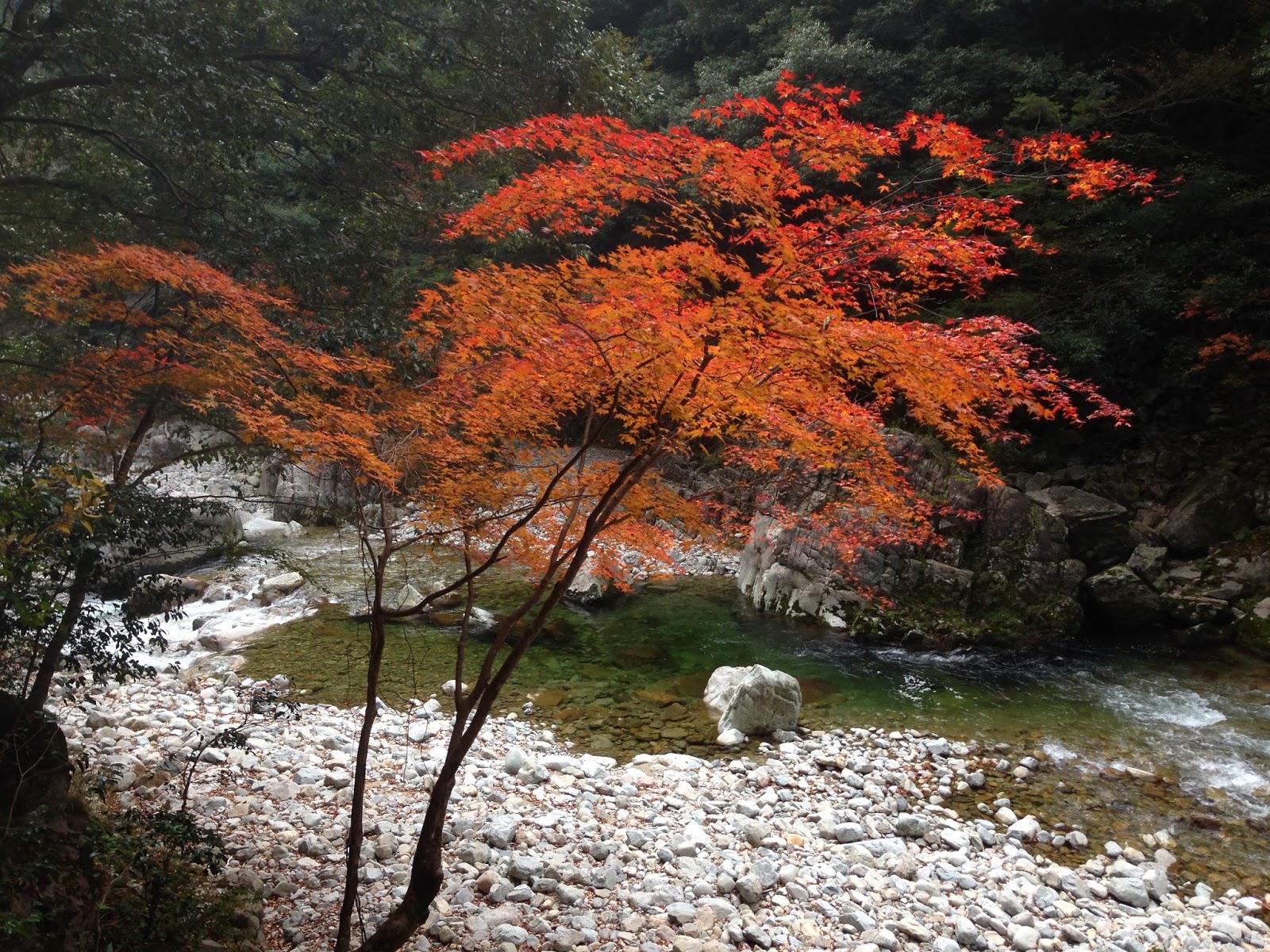
 I thought I would start with some pictures from our fall. Autumn doesn't really begin until mid-October and lasts until about early December. We enjoyed hiking in the mountains and viewing all the changing color of leaves. Below are some pictures from a gorge named Sandankyo Valley.


 Below are pictures taken on December 8th at a park by our house. Luke is still even wearing shorts!! Included is also a picture of Cameron's ever-growing independence and particular ways as a 2 year old!